
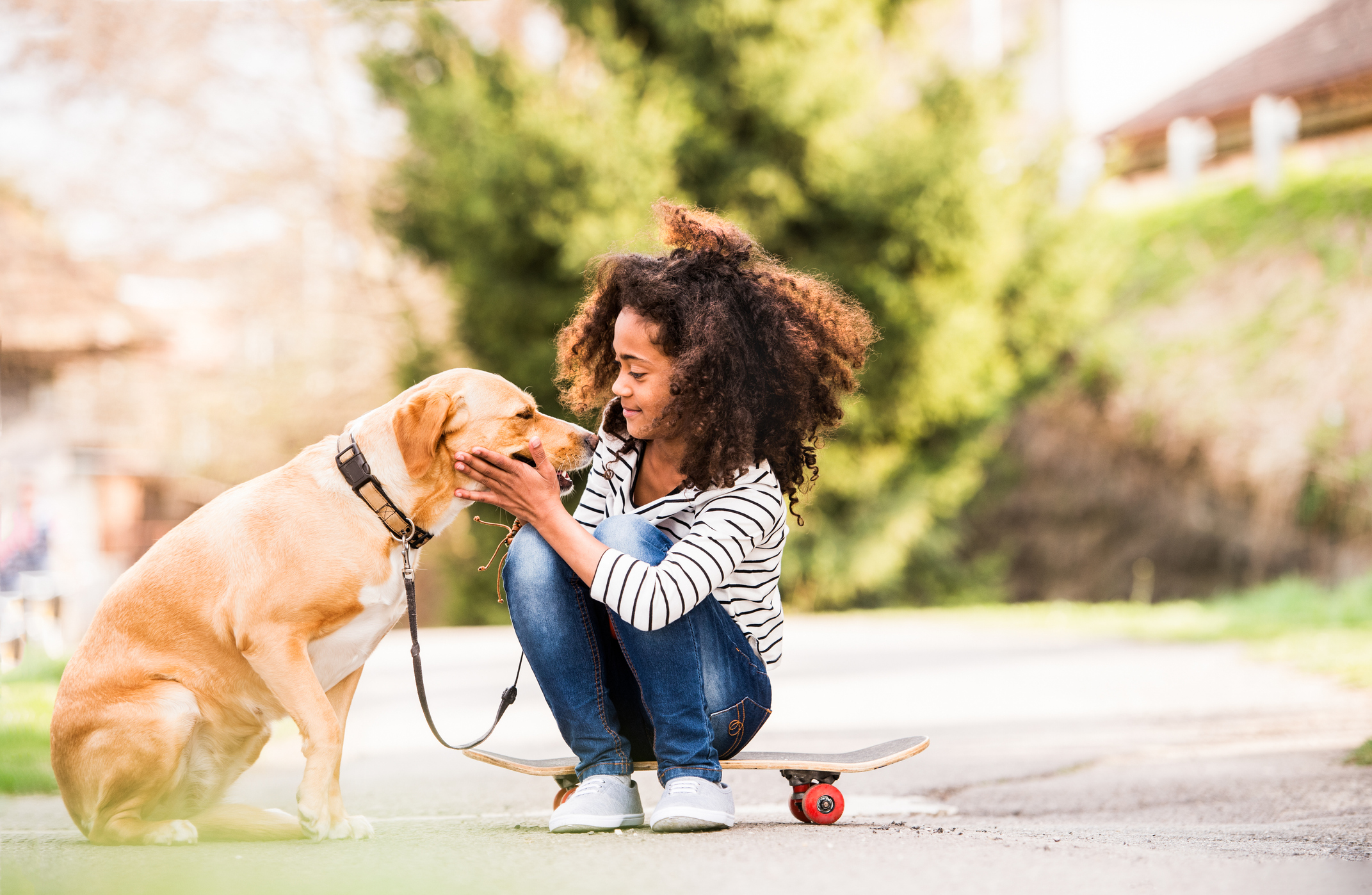
Sometimes, as a dog trainer, you encounter a dog that is fearful of children. Most people assume that the dog must have had bad experiences with children. While this is possible, it often has to do with a dog not being used to being around children, along with the characteristics of kids that can make them more unpredictable than adults or even other animals.
In this article, we’ll explain what makes kids different for dogs, and outline how you can train dogs who are fearful of being around children.
For dogs, why are children different from adults?
Children are different from adults in many ways, including:
- Size. Children are smaller in size. Since they are shorter, they can be close to eye level with a dog. Eye contact can be seen as a challenge by the dog.
- Unpredictable movements. Their movements (especially with young children) can be less fluid and jerkier. Think of a toddler learning to walk that takes a few steps and then stumbles, or kids running around while they play darting in different directions.
- Noise. Children can be loud whether they’re screaming, crying or having fun. The higher pitched noise can be unsettling for a dog.
All of this can be difficult for a dog that hasn’t been around children and therefore hasn’t been exposed to these differences. So, to move forward successfully with training, we need to determine if it’s all things children or one or more specific triggers so we know what to address.
You’ll also need to determine if it’s all children or a specific age range that causes fear for your dog. Are they young babies? Is it toddlers? It could even be teenagers. It’s important to know this so you can focus on the appropriate group.
A note about safety
Just because the dog is consistently around kids does not mean the fear will go away on its own. It’s highly unlikely that without intervention the situation will improve. Before we get into how to help the dog overcome the fear, we must emphasize that safety must always come first. A child should not be left alone with a dog in general, but definitely not in this situation. They will need to be monitored and likely kept at a distance until the behavior has been addressed.
It is also very important to teach children how to interact with dogs. In general, they should know to ask before approaching a dog. Children should be taught not to pull at a dog’s tail or ears and not to climb on them. Finally, a child must understand that if a dog tries to move away, it’s their way of escaping and they need to let them do it.
How to help your dog be more comfortable around kids
Now that you understand why a dog may be fearful of children, we can look at how to make the dog more comfortable.
In this case, we’re going to talk about the situation where the dog lives with children. This is a more intense situation because the stressor is there all the time. Management is going to be crucial! You are going to want to keep space between the dog and the child. It may mean using gates to separate the dog and children. It could be their crate is their safe place, and the child doesn’t go near it. Or maybe you can designate a room that the children don’t enter and the dog can relax.
Next we are going to work on building a positive association for the dog with children. We want the dog to learn that good things happen for them when children are around them. Most dogs love treats so we will plan to use them, but for a non-food motivated dog you could use petting, a favorite toy or praise.
We recommend utilizing a leash to ensure you can maneuver the dog away if it gets stressed out. We will reward the dog for being calm around the child. This will involve finding the dog’s threshold or the distance from the child at which the dog is non-reactive. We’re looking for the dog to be calm in the presence of the child. Look for a relaxed body position and normal breathing. This is where you will want to reward/treat the dog. If the dog is very relaxed, you can move a little closer to the child and see the dog’s reaction. If they maintain calm, you’ll want to give the dog treats there too. This will become your new threshold. If not, back up to where the dog is calm and treat them. End the session on a positive note.
The dog will dictate the pace at which you move forward. Putting too much pressure on the dog can cause you to lose the progress you have made or even make the fear worse. For future training sessions, start at the point just behind where the dog was last comfortable in the presence of the child. This will be a process of working on closing the gap between the dog and the child while keeping the dog in a non-reactive state. Keep the sessions short but frequent.
It will also be important to work through this sequence with the child exhibiting any behaviors that the dog finds stressful. To start, you will want the child to just be present. You can gradually increase the complexity by increasing the activity and/or noise level of the child.
In conclusion
When we bring a dog into our home around children, we all hope that they can act harmoniously with one another. Unfortunately, the reality can sometimes be different, and that is where it is essential to monitor your dog’s behavior and put a plan in place as soon as possible if required.
If you have any concerns about a child getting hurt or have doubts about working through this alone it may be helpful to get the help of a trainer with experience in this area. At Highland Canine Training, our trainers have the experience and expertise to work through these issues with you to manage your dog’s fear of children.
Related posts

Want To Take Your Dog To A Festival? Here Are The Dos and Don’ts
In this article, Shae Slabaugh (professional dog trainer based in Huntsville, AL) explains how to prepare to take your dog to a festival.
Meet Carlos Viera, Our Professional Dog Trainer Serving Huntersville, NC
Carlos Viera is Highland Canine Training’s professional dog trainer in Huntersville, NC. Learn more about Carlos in this Q&A.

How To Train A Deaf Dog
When working with a deaf dog, you will need a different approach to training. David Hamblin (professional dog trainer in Roanoke, VA) offer some tips.

You must be logged in to post a comment.