
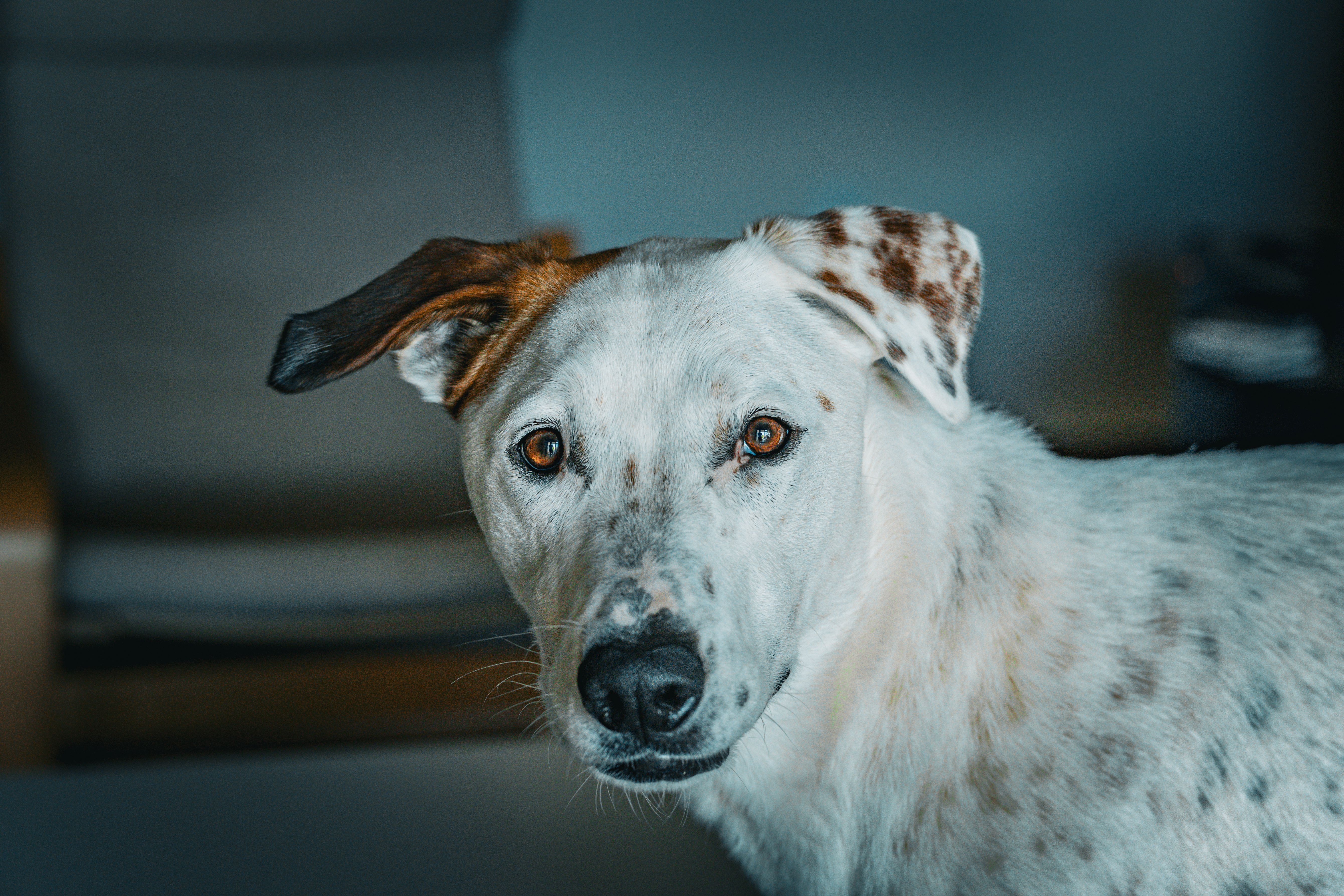
Let’s imagine that you adopt or purchase a dog, and you find out he or she is deaf. You are now in the unique position of training or trying to train your dog to follow commands, but purely relying on verbal communication is not going to be successful.
Hiring a professional dog trainer who has had experience in training a deaf dog is one option – or you can attempt it yourself by following these suggestions.
Deaf dogs in America - the statistics
Before we talk about training, let’s look at the information on deaf dogs in the United States.
Somewhere between 5%-10% of dogs in the country have some form of deafness in one or both ears. Because the number of dogs born each year fluctuates dramatically, we can only estimate that about 35,000 dogs in the country are deaf in both ears and 120,000 dogs have hearing issues in one ear.
Congenital deafness in dogs can be strongly linked to the genetics of certain breeds, particularly those carrying the Piebald gene (white coat) and Merle genes.
When it comes to specific breeds, studies have shown 30% of Dalmatians are born with deafness in one or both ears and 14% of English Setters are deaf in at least one ear. The prevalence of deafness can vary by breed.
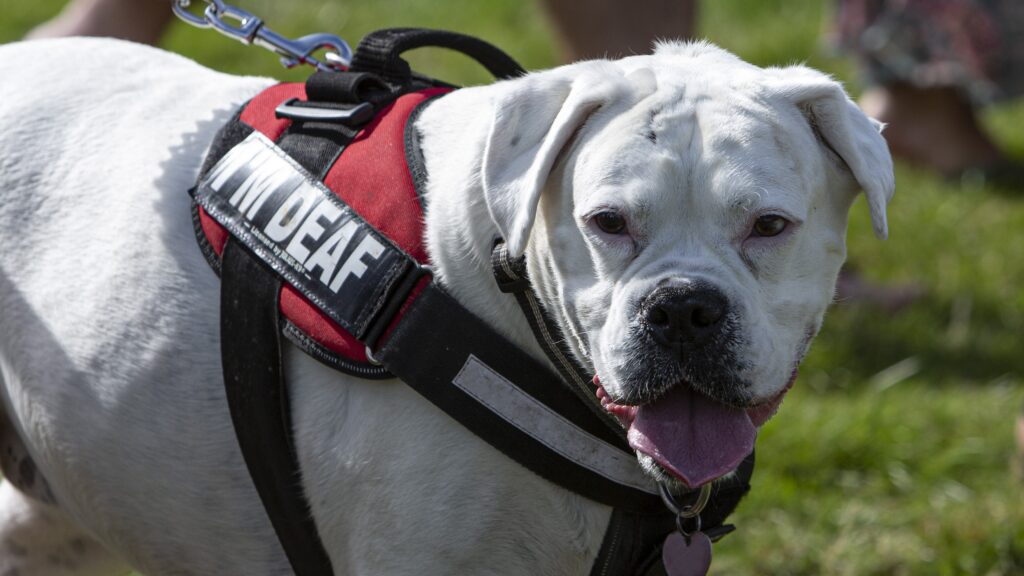
Training a deaf dog - step-by-step
When it comes to training a deaf dog, the work is pretty straightforward. To train your deaf dog and make the work fun and interesting, you need food/treats or a reward of high value, a leash, and yourself.
We firstly want to think about our communication with our dog in training and moving forward. We know that dogs learn our body language cues very quickly, and the use of hand signals is very effective. I like to use hand signals that coincide with the behavior – clear and concise messaging for our dog.
One of the first signals I want to teach a deaf dog is a marker or affirmation cue, like we would use with a clicker or verbal markers. I like to keep it simple. My physical marker to the dog for giving me the behavior I want, is giving the dog a thumbs up, immediately followed by a treat (reward). To teach the dog what the thumbs up means, we want to “charge” the marker. We do this by showing the dog the thumbs up followed by the treat. You want to do this 15 times per session, and plan to do 2 to 3 sessions a day for 4 or 5 days. You will know you have “charged” the marker, when the dog looks at you immediately after you give him the thumbs up.
Once you have established with your dog what the marker is, move forward to the next behavior you want. If it’s the Sit command, I am going to have my dog attached to my leash to keep him from wandering while we are working on the behavior. I am going to use my treats/reward to get the dog’s attention. Once I have the dog’s attention, I place the treat in front of the dog’s nose and slowly move my hand up and backwards to lure the dog into a sitting position, then give the thumbs up marker, followed immediately by a treat. Think about it like this – when the head goes up, the butt goes down. The motion of my hand luring the dog into a sit position by raising my hand, with my palm upward becomes the cue. Practice this two or three times a day in short sessions.
Once you have established this behavior, move on to the next. When I want the dog to look at me, I will tap the dog on his rear end twice. When he turns and gives me eye contact, I give my dog the thumbs up marker, followed immediately by the treat. Again, practice this 2 to 3 times a day, short sessions, for several days until the behavior is established.
Your hand signals should mimic the behavior you want. Remember to keep the training and hand signals clear and fun for the dog. Don’t hurry the progression of the learning process – small bites of the apple will make you a winner. Also, remember to practice and teach the behaviors in different areas and environments.
In conclusion
Training a deaf dog doesn’t have to be difficult, but it does require patience, work and commitment. Doing it yourself can be fun and rewarding, but it does take time.
If your schedule doesn’t allow to work with your deaf dog, contact us here at Highland Canine Training. We have a team of professional dog trainers that would be happy to help.
Related posts
Meet Carlos Viera, Our Professional Dog Trainer Serving Huntersville, NC
Carlos Viera is Highland Canine Training’s professional dog trainer in Huntersville, NC. Learn more about Carlos in this Q&A.

Why Dogs May Plateau During Training
Has your dog’s training progress stalled? In this episode, we look at why training can plateau – and tips to resolve it.

Why Do Some Dogs Learn More Quickly Than Others?
Have you ever wondered why dogs learn at different speeds? There are so many factors that can affect how quickly – or slowly – your dog grasps a new behavior.

You must be logged in to post a comment.