
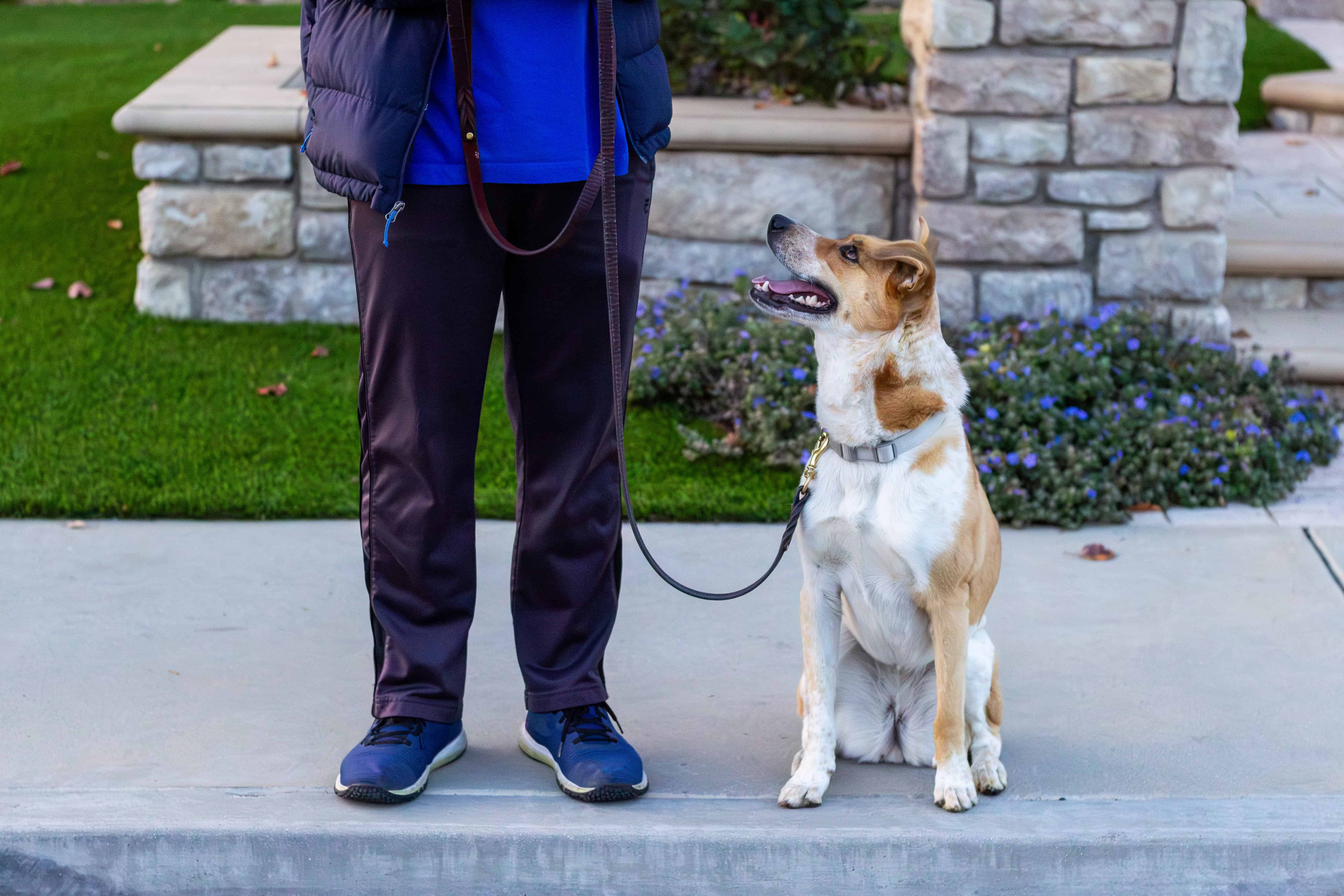
Have you ever worked with your dog – perhaps on a new obedience command, or when trying to resolve a behavioral problem – and for some reason, you’re just not seeing progress? You’re doing all the right things, such as working with them consistently and engaging them in short training bursts, yet no matter how hard you try, the training just doesn’t seem to stick with them.
There can obviously be a number of reasons why you may not be seeing sufficient progress in your dog’s training, but one of the most common factors is timing. Of all the skills you can develop as a handler – whether that’s for your pet dog, a service dog, or a Police K9 – your timing is vital. Get the timing right, and your dog understands what is expected of them; get it wrong, and you’ll run into inevitable roadblocks and communication breakdowns.
In this article, we’re going to break down why timing matters so much when working with your dog, and how you can work to improve your timing skills.
How dogs actually learn
Before we begin, it is really important to first understand how dogs actually interpret and understand our instructions.
You may be familiar with the term ‘operant conditioning’, which is a learning process defined by B.F. Skinner. In operant conditioning, behaviors can be altered through the consequences (positive or negative) that follow them. In essence, reinforcing positive behaviors means they are more likely to be repeated, whereas penalties can discourage unwanted behaviors from occurring. There are four quadrants of operant conditioning:
- Positive reinforcement – Adding a desirable stimulus (ex: treat, praise, toy) to increase the likelihood of a behavior occurring.
- Negative reinforcement – Removing an aversive stimulus (ex: loud noise, leash pressure) to increase the likelihood of a behavior occurring.
- Positive punishment – Adding an aversive stimulus (ex: verbal correction, training tools) to decrease the likelihood of a behavior occurring.
- Negative punishment – Removing a desirable stimulus (ex: stopping playtime, removing treats) to decrease the likelihood of a behavior occurring.
It is important to note that in this context, positive means adding, while negative means removing.
Why timing matters
Now that we understand the principles of operant conditioning, we need to understand how applying the framework in a dog training setting can have an immense impact on the success of our training.
Dogs tend to live in the moment – they are genetically more instinctive creatures than humans. As an example, let’s imagine that you tell your child to tidy their room. If they do not tidy their room immediately, they will likely still remember in a couple of hours that you asked them to do this. You can reason and explain to them, and choose an appropriate consequence that may encourage them to tidy their room more expediently in the future.
Dogs are totally different. They respond to the consequences of their behavior immediately. They will not understand a request that occurred hours, minutes, or sometimes even seconds ago if it has been usurped by another request. It boils down to this – if you ask your dog to perform a behavior, you cannot wait or hesitate to communicate to them if they are responding correctly to your training. You have to let them know immediately.
This is where we often see dog owners run into obstacles with their training. It isn’t that the dog is being “stubborn” or simply “isn’t listening”; instead, the problem is that the communication is not clear. Even a one or two second delay can affect the success of your training.

Examples of how timing can impact training outcomes
Whether you’re training a pet dog, a service dog or a working dog, timing is crucial. Here are a few examples in different scenarios of how good (and bad) timing can make a difference.
- Pet dog (obedience). You ask your dog to perform the Sit command. Here, good timing would be that once the dog performs this command, you deliver a treat to reinforce the behavior. However, if you wait several seconds and reinforce when your dog stands back up, this would be poor timing as it would not create an association between the command, the behavior and the consequence.
- Pet dog (behavior modification). You are practising with your extremely reactive dog at a safe distance, calmly watching other dogs pass by. Good timing is rewarding the dog for calm behavior or disengagement to build a positive association. However, if the dog begins to lunge and bark, they are now over threshold and it is harder for them to learn as their stress response has taken over. In this situation, timing is knowing when your dog is about to pass their threshold, and this is why it is essential to be systematic and precise when dealing with behavioral cases.
- Service dog training. You are working with a service dog candidate in public around distractions, to ensure they can complete tasks even in busy environments. Good timing is reinforcing at the precise moment the service dog ignores distractions and focuses on their task. Poor timing would be if the reward came several seconds later, when the distraction has been replaced by something else or if the service dog is now out of active task mode.
- Police dog training. You are training a drug detection K9 to improve their indication when they locate target odor. Good timing is reinforcing the dog when they have clearly indicated on their target odor; poor timing would be reinforcing too soon (when you aren’t sure that the dog has located the odor) or reinforcing too late (when the dog has veered away from the odor or moved on to something else).
How to improve your timing as a dog owner
The reality is that many dog owners – no matter how experienced they are – can struggle with timing. It can be frustrating to work continuously with your pup, only to see little to no substantial progress.
The good news is that there are a few ways you can improve your timing. As with most aspects of dog training, working on being consistent – using the same commands, having the same expectations, and responding in the same way – can help to build clear communication with your dog. Inconsistency in your timing is only going to create more confusion for your dog and slow the learning process.
It might sound unusual, but recording your own training sessions can also be very valuable. When you are in the middle of training, you may become conscious and start to second guess yourself – and this, in turn, can impact your ability to be consistent with your timing. When you set up your phone to record your sessions, you can then watch back and see if you were actually being consistent. This can also be great for troubleshooting, particularly if you begin working with a professional dog trainer.
In conclusion
Dog training isn’t always easy. There are so many factors that can make or break your training progress – and timing is everything. By following the tips in this article, you can begin to build consistent, repeatable habits that can improve your training outcomes with your dog.
Related posts

How To Use Your Dog’s Mealtime As A Training Opportunity
In this article, Tabor Tiffany (professional dog trainer in Rifle, CO) explains how you can use mealtimes to train your dog.

Why Zak George* Is Ruining The Dog Training Industry (*And Other ‘Influencers’)
Social media influencers and force-free absolutism continue to dominate dog training discussions – but what impact is this having in the real world?

How To Train Dogs With Specific Fears
In this article, Corey Archer looks at how to approach training a dog who has a specific fear.

You must be logged in to post a comment.